Walk into a dental practice today and ask the front desk what patients are calling about, and implants will come up fast. A treatment that was once niche, expensive, and a little intimidating has moved firmly into the mainstream of patient requests. The shift didn’t happen by accident, and for practice owners and healthcare investors alike, it’s worth understanding what’s actually driving it.
A Demographic Tailwind
The simplest driver is age. Populations across most developed markets are getting older, and older patients are exactly the group most likely to have lost one or more teeth over a lifetime. But here’s what makes this generation different from the ones before it. They’re staying active longer, they tend to have more disposable income, and crucially, they aren’t willing to quietly accept ill-fitting dentures the way their parents’ generation often did.
That combination, more people needing tooth replacement and more of them expecting a premium, permanent solution, has pushed implants from an occasional, specialized procedure into a steady and predictable stream of business. The demand isn’t a spike. It’s a structural trend with years of runway behind it.
Awareness Has Caught Up
Ten or fifteen years ago, plenty of patients simply didn’t know implants existed as an option. The default mental model was dentures or nothing. Now patients arrive at the consultation having already read about implants online. They’ve seen a friend’s or relative’s results across the dinner table. They’ve watched explainer videos and scrolled through before-and-after photos. The patient education that practices used to do from a standing start is now partly complete before anyone sits in the chair.
This changes the entire conversation. Instead of convincing someone that implants are real, safe, and reliable, the discussion moves straight to candidacy, timing, and cost. That’s a warmer, more advanced starting point, and it meaningfully shortens the path to treatment acceptance. A patient who already wants the solution is a very different prospect from one who’s never heard of it.
Technology Lowered the Barriers
On the clinical side, the field has matured at speed. Digital intraoral scanning, computer-guided surgery, and improved implant materials and surfaces have made procedures more predictable and, in many cases, considerably less invasive than the patient fears walking in. Predictability matters enormously for a practice’s reputation, and in an age of online reviews, reputation is its own marketing engine, running quietly in the background whether you tend it or not.
Shorter treatment timelines in suitable cases also help close deals. When patients learn that a solution can be more efficient and less drawn-out than they assumed, a major source of hesitation simply evaporates.
What This Means for Practices
For a practice deciding whether to invest seriously in implant services, the demand signals are genuinely encouraging. But capturing that demand takes far more than buying the equipment and waiting. A handful of factors separate the practices that thrive in this space from those that dabble and stall:
- Clear patient communication that explains the why behind the recommendation, not just the what and the how much.
- Transparent pricing and flexible financing options, because cost remains, by a wide margin, the number one source of hesitation.
- A thoughtful referral relationship strategy, since general dentists and specialists frequently share these cases between them.
- Visible social proof, in the form of polished before-and-after results and authentic patient stories.
Patients researching their options will almost always compare several providers before booking a single consultation. Those who land on practices offering dental implants with clear information, transparent costs, and a confident, well-presented process are far more likely to convert than those who hit vague answers, a guarded receptionist, and a quote with no context attached.
The Financing Conversation
It’s worth dwelling on cost, because it’s precisely where so many promising cases quietly die. The patient wants the treatment. The clinical fit is there. The relationship is good. Then the total number lands on the table and the momentum drains out of the room. Practices that have figured out flexible payment structures, third-party financing partnerships, and phased treatment plans consistently report higher acceptance rates than those that present a single intimidating figure and leave the patient to wrestle with it alone. The demand is real, but it has to be made affordable to translate into actual revenue and treated cases.
A Market Still Growing
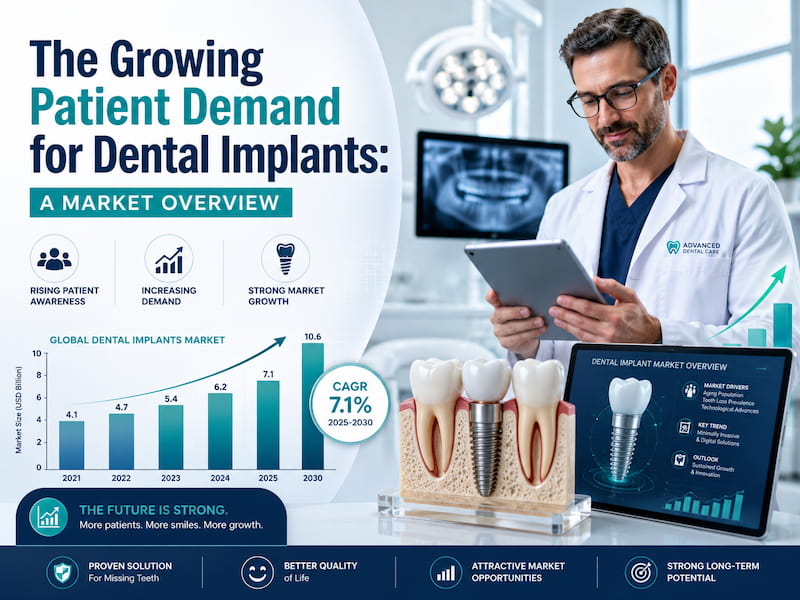
Market analysts continue to project healthy, sustained growth for dental implants over the coming years, driven by the same demographic and awareness trends rather than any short-lived fad. For practice owners and the broader dental industry, that’s a long and reliable runway. The strategic question, then, isn’t really whether demand exists. It plainly does and continues to expand. The question is whether a given practice is positioned to meet that demand credibly and capture its fair share of it.
Positioning for the Long Game
The practices that genuinely win in this space tend to treat implants not as a one-off procedure buried in a service list, but as a signature offering, something they become known and sought out for in their local market. They invest in training their entire team, not just the lead clinician. They refine their consultation process until it consistently builds confidence. And they cultivate the kind of trust that makes a hesitant, cost-conscious patient ultimately say yes. The demand, in the end, is the easy part. Earning it, case by case, is the real work.
Did you find this helpful? Check out our other helpful articles on our website.
Read Also
- The Growing Patient Demand for Dental Implants: A Market Overview
 Walk into a dental practice today and ask the front desk what patients are calling about, and implants will come up fast. A treatment that was once niche, expensive, and a little intimidating has moved firmly into the mainstream of patient requests. The shift didn’t happen by accident, and for practice owners and healthcare investors… Read more: The Growing Patient Demand for Dental Implants: A Market Overview
 - The Growing Need to Introduce Yoga Therapy in HospitalsDid you know that yoga means a union between the mind, body, and soul? It is an ancient form of physical healing tracing back 3000 years ago. Yoga improves or balances mental focus and eases body pain. Since the 18th century, its popularity has risen; now, over 36 million Americans perform yoga daily. Today, yogic… Read more: The Growing Need to Introduce Yoga Therapy in Hospitals
- How to Identify the Right Healthcare Franchise for Your Investment StrategyAre you an investor looking to capitalize on the ever-growing healthcare industry? Investing in a medical franchise can be a great way to diversify your portfolio and take advantage of ever-changing trends in the sector. To help you make the right choice, we’ve compiled this guide outlining all the key factors that will inform your… Read more: How to Identify the Right Healthcare Franchise for Your Investment Strategy
- Global Diagnostic Imaging Services Market to Grow by CAGR of ~6% During 2023 – 2033Research Nester published a report titled “Diagnostic Imaging Services Market: Global Demand Analysis & Opportunity Outlook 2033” which delivers a detailed overview of the global diagnostic imaging services marketin terms of market segmentation by product, application, end-user, and by region. Further, for the in-depth analysis, the report encompasses the industry growth indicators, restraints, and supply… Read more: <strong>Global Diagnostic Imaging Services Market to Grow by CAGR of ~6% During 2023 – 2033</strong>
- What You Need to Know About Big PharmaWhen you trip and hurt your knee in real life, you take some pain medication and it starts to feel alright again. The same goes for the bruises you got when you were little – a trip to the pharmacist and you’ve got a nice soothing cream. Sounds lovely, doesn’t it? There’s a darker side… Read more: <strong>What You Need to Know About Big Pharma</strong>
- Best Healthcare Businesses That Don’t Require a DegreeStarting a business in the healthcare industry can be a rewarding and profitable venture,but it’s not always necessary to have a degree to be successful. Here are a fewexamples of healthcare businesses that can be started without a degree: 1- Medical Billing and Coding Medical billing and coding is a necessary aspect of running a… Read more: Best Healthcare Businesses That Don’t Require a Degree
- Global Digital Map Market: Guiding the New EraToday, the world is moving towards digitization more rapidly than ever. The digital versions of tools and techniques have replaced the conventional ones. Digital maps have become very prevalent in recent years. The world is using them to know the distance and time needed to reach a certain destination from one point. Nowadays, maps are… Read more: Global Digital Map Market: Guiding the New Era
- Malaysia dental Services Market Outlook to 2026FRising General Dental Awareness The general awareness regarding the oral health and the demand for public dental policies is proving to be an important factor for the rise in dental services market in Malaysia. Factors like better standards of living, changing economy have been a reason for growth in the market. Increasing Demand For Laser… Read more: Malaysia dental Services Market Outlook to 2026F